
Build Your Inversion Practice with the Right Support
Key takeaways
- Inversion therapy uses gravity to help decompress the spine and relieve built up tension in the body
- Practicing inversions can support circulation, mobility, and recovery by changing how the body experiences load
- Combining inversion with massage balls can enhance tissue hydration and release tight muscles and fascia
Inversions are coveted among yogis. Yoga is one of the few systems of health that suggest you regularly turn yourself upside down for extended periods of time. The health benefits of inversion therapy are astonishing: it reverses aging, increases blood flow to the brain, regulates pituitary and pineal glands, relieves constipation, tranquilizes and mellows the nervous system, and the list goes on. Responses vary from person to person, but a regular practice of turning upside down to one degree or another is soothing and balancing, and it can be a necessary step for many to stop their chattering minds before meditation.
What Counts as an Inversion?
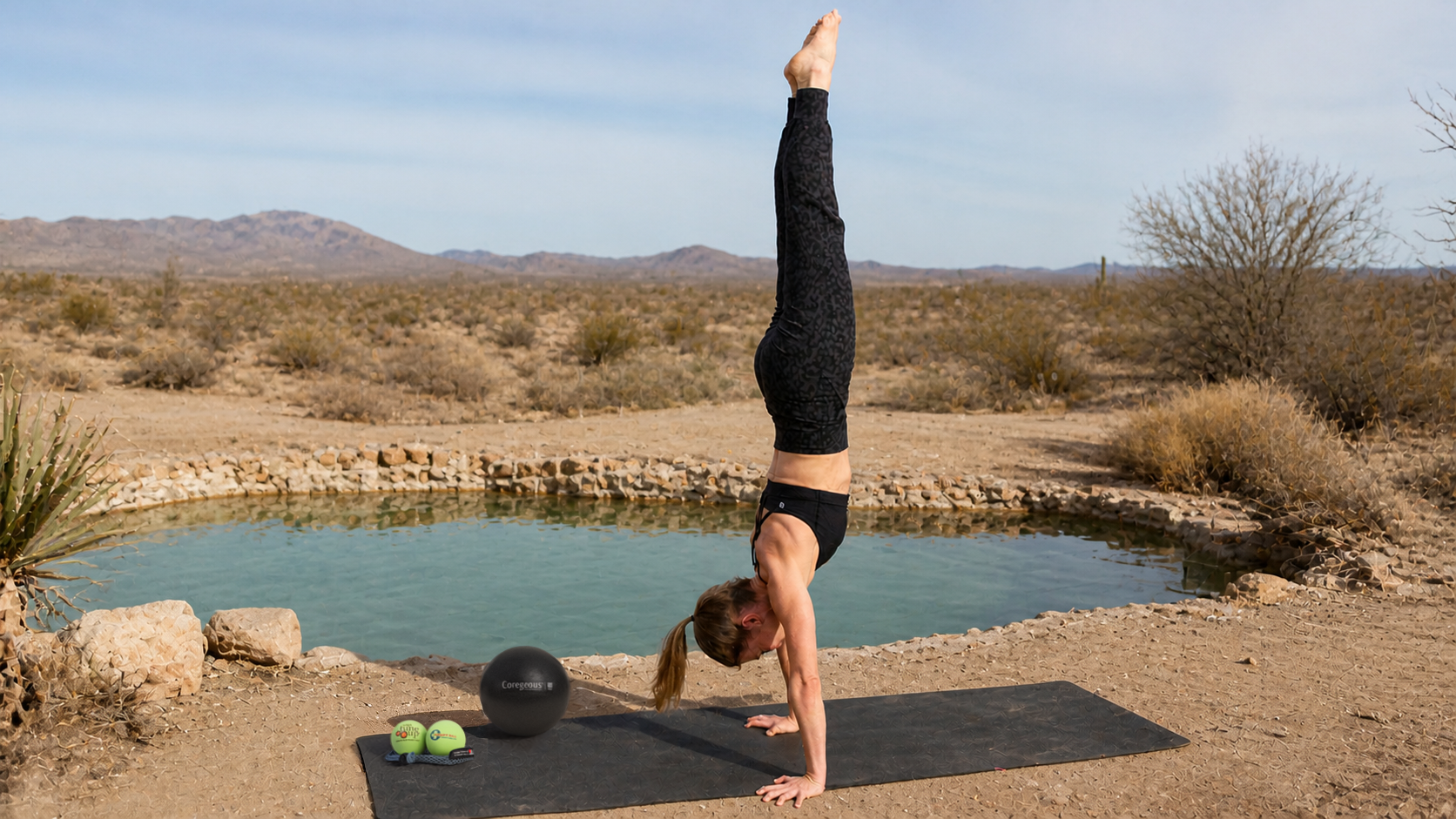
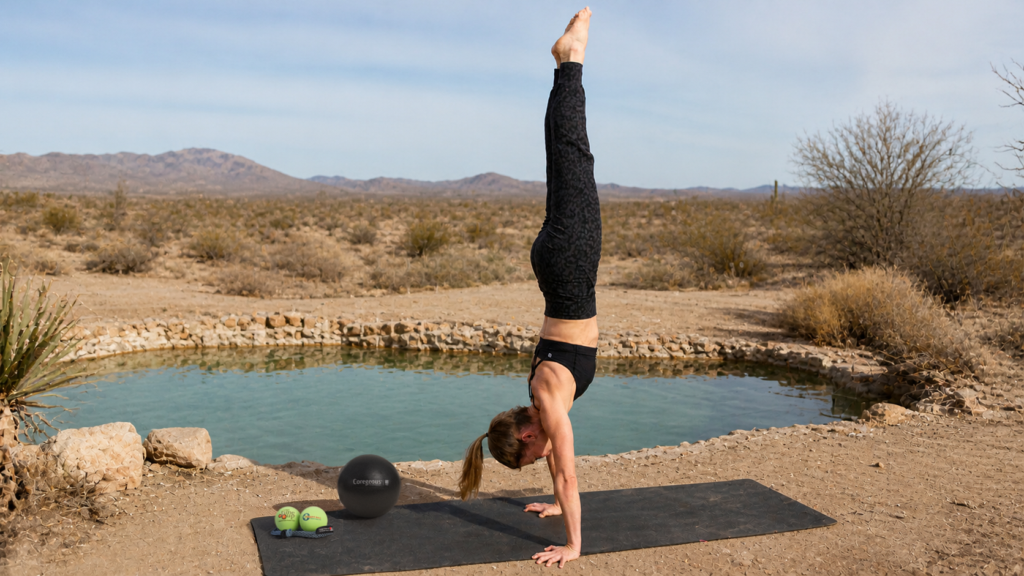
Inversions can include a broad range of poses, both yoga and commonplace stretching positions. Simply hanging your body forward while sitting in a chair can be enough to reset your inner rhythm. Downward dog is an inversion, as is Legs Up the Wall Pose. And then there are some more intense inversion poses like headstand, shoulderstand, handstand and plow.
The Circulatory and Respiratory Benefits of Going Upside Down
Inversion poses are excellent for aiding in draining blood and lymph from the lower extremities and the abdominal and pelvic organs. They are also a great stretch for the diaphragm. All inverted poses significantly increase blood flow to the brain, heart and lungs. This extra flow helps to saturate the often neglected upper lobes of the lungs with a fresh wash of blood and stimulates action in its upper air sacs (arterioles).
How Yoga Inversion Poses Turn Off the “Fight or Flight” Stress Response and Support Your Body’s Relaxation Response
Inversion therapy yoga also directly triggers certain relaxation responses in our bodies. Whether the inversion is subtle or extreme, the pull of blood towards our hearts and heads toggles our nervous systems to turn off the sympathetic “flight or fight” stress response while turning on the parasympathetic “rest & digest” response. This happens in a complicated feedback loop that starts when blood pressure accumulates in the aortic arch above the heart and the carotid arteries in the neck. The final result is that they quiet the “chatterbox” centers within the brain itself so that we can have some peace and quiet.
Who Should Approach Inversions with Caution
Students with high blood pressure are advised against aggressive inversions such as headstand, shoulderstand, or plow. Certain students who have lost their cervical curve are at serious risk when doing headstand or shoulderstand. Students with degenerative bone disease or detached retinas are also strongly discouraged. Functionally, we were not made to put all of our body’s weight on the neck bones, whether in flexion, extension or neutral. A healthy headstand or shoulderstand needs strong arms, shoulders, and core muscles to displace some of the body’s weight from the neck and skull. When settling in for an inversion, give yourself some time, make sure your practice space is quiet and warm, and dim the lights for an optimum result of calm.
Learn more about breath and down regulation:

It has never been explained to me in Yoga classes before of the benefits of inversion, ie…handstands, headstands, which are mostly performed. I just thought it was a strength move. This is good to know, especially since stress is so predominant in our society, and is such a silent killer.
I do love to do a headstand from time to time, just for fun, but I have to admit that I get into the post in a not so safe way, since I always thought my arms are simply too short. I googled more information, got the impression that I was wrong and kept trying. However, in todays training I learnt that my arms are too short and that I should simply stay away from it. Fair enough, EVERY BODY is different.
Jill,
Nice article.
For those looking for a more “restful” inversion, try legs up the wall… It’s heaven on earth!
Very nice article, Jill. Haven’t seen inversion explained in such a way before.
Got to try out the downward dog position now.
I really appreciate this article on so many levels.
Especially the reminders that to have an inversion practice, one doesn’t necessarily have to be in a handstand to reap the benefits.
Thank you for that list as well as the beautiful reminder.
Im curious…Ive recently been in some discussions of using inversions in terms of hormone balancing/regulation.
I do have a lot of peri-menopausal and menopausal students looking for more natural avenues to balance this challenging phase of life.
Id love to know if yourself or anyone here has any additional resources or articles pertaining to that that I could get connected with for further research.
Thank you!
Enjoyed the many options of inversion choices. Often times we think only of the most “impressive” poses as being inversions. Also appreciate the mind, body & soul benefits of inverting. The cautions were helpful as well, knowing that a “cool” inversion isn’t worth serious and sometimes irreversible damage to the cerivical spine and head.
I have been reluctant to try inversion therapy as I am fairly new to yoga and do not feel yet that I have the confidence to be completely upside down. This is one of the reasons why I was so interested to read the suggestions that you have made to get started with inversion, such as the Downward Facing Dog pose. I was already in no doubt that I would benefit from this, it was just the actual process of being inverted that I was not completely sure of. However, I am sure that in time I will be able to manage a handstand as my confidence improves.
What a wonderful reminder to work more inversions into our practice. There is an uplifting energy in the room after a class full of yogis have made there way into an inversion. Although I do experience a reduction in stress and clarity after handstand I wasn’t aware why. Thank you, I know I will refer back to this post often to be reminded of the many benefits inversions have to offer.
I walked away from my computer in the middle of reading this article to go upside-down.
One of my students recently asked me, “What’s the point of doing inversions in yoga?? It seems like there just here to frustrate me.” It’s great to have some more benefits to share!
In my practice, inversions, particularly handstand, were a reality check for me that something was out of balance in my body. I’m naturally flexible, so I could kink myself into a lot of positions (in not-so-healthy ways), but I could never stick handstand away from the wall. When I started rehabilitating my inevitable overuse injuries with the sole intent of getting out of constant pain and bringing my body back into balance, handstand started showing up for me. I aspire solidly hold handstand for several, not for the bragging rights or Instragram photos, but because I know how balanced and strong my body will be when I am able to do that.
Again I found this article inspirational. I have decided that because my focus in tomorrow’s teaching is on Uttasana, an inversion as my peak pose (I’m in YTU-Level 1 Training) I am going to turn the lights down low and bring a little of a Restorative vibe to the practice. I am sure my fellow classmates are all stressing a little tonight…so leading them through a mini-sequence as a slow, gentle pace might help them with their sequence…we think better when we chill out.
[…] it. Inversions take some pressure off your spine, help regulate the pituitary and pineal glads and helps trigger the relaxation response of the parasympathetic nervous system. But besides that, it just helps quiet the mind down and give you a new perspective. When […]
I love practicing inversions because the make me feel good but I didn’t know the reason behind the good feelings. Its so amazing that they help bring us into “rest and digest” to calm our minds.
Loved learning about the connection that inversions can help turn off mind chatter before meditation.
The versatility of inverted poses ranging in intensity is pretty neat considering all the benefits each can offer. From legs on the wall to a full headstand. Pretty amazing.
I just learned in Judith Laseter’s Relax and Renew Restorative Yoga book that legs on the wall can help alleviate edema, yay!
I helped someone do a handstand yesterday. He was very stressed out before and after 20-30 seconds of the handstand he seemed more focused and relaxed. I do believe that handstands can improve your mood because you’re getting that fresh surge of blood to your head and it makes you feel like a little kid again.
I find a gentle inversion a wonderful way to combat stress. Viparita korani mudra is my favorite, as it’s about as gentle an inversion as you can get. It’s especially valuable to me, as I spend much of my day on my feet in a retail environment on concrete floors. It’s ideal for a late evening meditation right before bed. It helps me down-regulate and often it will take all those extraneous thoughts and worries from the day and sends them right out into the ether. Since I started practicing this pose regularly, I find I have far less trouble with insomnia.
I love a good inversion! As much as I’ve enjoyed exploring my way through shoulder stand and head stand (I haven’t got the guts for handstand yet), I also enjoy hoisting my sacrum up onto a block and elevating my legs, sometimes with a wall, sometimes without. I do find it offers me some clarity and quiet my incessant monkey brain.
I’m studying Yoga Tune Up as part of the 200 Hour Yoga Teacher Training Course at Yoga Garden in San Francisco. I was definitely apprehensive when I first tried inversions, but was surprised to find they really helped clear my mind. This article is helpful in understanding why and also types of students for whom inversions would be unsafe.
[…] Learn more about this topic as you visit these web pages: http://www.ehow.com/how_8383412_use-marcy-inversion-chair.html, http://www.ehow.com/video_2351775_yoga-headstand-inversion-chair.html, and http://www.yogatuneup.com/blog/2010/06/04/inversion-yoga-therapy/. […]
I really enjoy inversions such as the headstand & handstand whereas the shoulderstand just cause stress and discomfort. I wish more yoga teachers could/would give advice on when certain inversions may be contraindicated, and when it’s safe to try the more challenging inversions. Most teachers mention the menstrual cycle, but very few talk about limited range of motion as something to be aware of as well.
i had a breakthrough this weekend in my teacher training! finally achieved Adho Mukha Vrksasana! i have been working for sometime on this asana and it all seemed to ‘click’….and oh how my deltoids were ‘singing’ this morning. it will be a long time before i leave the wall in this pose but sirsasana now has a companion when it comes to my favorite inversions.
I still remember the first headstand I did as an adult…away from the wall….center of the studio… with my teacher by my side offering encouragement and guidance. We’d been working on the preparation for some time, building arm strength, allot of dolphin at the wall among other things… so as I prepared, and slowly moved into the posture, I found I had to concentrate on my breathing more than usual. There was this sense of exhilaration (along with a voice in my head that kept saying ‘omg, omg, you’re doing it’). I remained inverted for a good 25-30 seconds and when I came down, I just smiled, red-face and all. I equate the feeling in that moment to when I was a child and rode a bike for the first time. Training wheels off, Dad holding the back of the seat ever so slightly until I got going, then, without me knowing, he released…and I was doing it! That first headstand was maybe 10 years ago, and even today, in my morning practice, I felt a peaceful sense of accomplishment as I appropriately rested in child’s pose. There are so many benefits to inversions that I’m only now starting to comprehend, so I just wanted to say thank you to Amy for starting me on my journey oh so many years ago.
I must work inversions into my practice more: tonight I came home and was all stressed up with no place to go…no place, that is, but my yoga mat. It took a while for me to find the inversion that didn’t get me even more stressed out than I already was–I finally decided to go with good ol’ Adho Mukha Svanasana (downward facing dog) and played around with a combination of ratio breathing as well as the abdominal, thoracic and abdominal/thoracic abodes of breathing to help put the kibosh on the paniced chatter in my head and tap me into my parasympathetic nervous system. i hung out in the pose for about 5-8 mins, taking breaks in Balasana (child’s pose) when needed. While I can’t say that my stress was completely alleviated, it definitely dissipated and my shoulders were able to relax and depressed from where they were (up around my ears) before I the inversion.
I like that inversion not only are helpful to the body but also to the mind. Have you ever really tried to look at your life from and upside down view. Things always look better once you’ve turn them upside down. I believe you can really see better afterwards. Thanks
Inverting the head below the body is very refreshing, two of my favourite poses are the upside down forward bend (urdhvamukha paschimatanasana), which gives a great stretch along the back, refreshes the shoulders (flexed and externally rotated), and protects the neck as the weight is placed on the upper back (scapula). The second pose is a supported plow (halasana) with the thighs on a bench or chair which relieves the weight on the shoulders and allows greater relaxation. Both of these require significantly less effort than a shoulder stand, handstand or headstand but provide the same restorative benefit of placing head below the body.
I love inversions! They have brought a deep sense of peace to my life. Years ago I was plagued with neck and shoulder disfuction and intense pain. My intution was always telling me to hang upside down. It wasn’t until I listened inward did I begin to feel the relief.
What down sides are there to doing handstands? I’ve noticed after doing a few hand stands that my eyes are bloodshot. Is that bad? I can also feel the blood draining out of my legs. And it actually kind of hurts…it’s at least not very comfortable. Not sure if I’m doing something wrong.
love this,its so true! a teacher once told me”if life gets you down,stand on your head” and i sure did. stressful day at work,i was in the back in head stand for a few minutes and instant gratification. its a double whammy,stress relief and muscle tone, i have also given this advice to some of my patients. glad to know its actually valid scientifically.
One of my favorite things to do when I am very stressed out at work is to sneak into an empty office and do handstands. It started when I was very stressed out, but now i do them everyday on my lunch break. It’s like an adult version of recess!!
Holding an inversion for a “safe” amount of time always depends on the health of the person doing the inversion, the type of inversion and many other factors. There is no “blanket formula” for how long one should hold an inversion…and a competent instructor should be consulted first.
Regarding Ariel question about students with lung or brain cancers, inversions are definitely inadvisable, and anyone with a severe medical condition such as this should be under the watchful eye of a medical doctor and a yoga instructor who specializes in working with cancers. Rita Trieger is an expert in all matters yoga and cancer…please visit her informative blog: http://ritatude.blogspot.com/
How long do you recommend holding an inversion pose safely?
I love inversions!!! Thanks for a reminder on all of their benefits!
I have to admit legs up the wall is a favorite relaxation pose of mine. It just feels so great to put your feet UP. I am working on my inversions but still need some more strength in my core and arms. Hopefully soon!
You mentioned the lymph system and an increase in blood supply. I’m wondering how inversions might affect someone with either lymphoma or any sort of lung or brain cancer. Would inversions be advised against in these instances?
I really do enjoy inversions. I recently was able to do headstand and I can feel the benefits to my nervous system and blood flow!
I always enjoy classes with inversions. In some ways, handstand against the wall seems like it’s one of the safer balance inversions since there is no strain on the head or neck. So many muscles are involved and it’s a great pose to ensure being present.
Inversions are important to me because they literally change my perspective! I would imagine it’s challenging to come out of a headstand or shoulderstand without feeling at least a little bit better.
I like going upside down. It makes me feel like a kid again.
Inversions are intimidating to new people. Ideally, new students can practice in smaller classes or classes that are appropriate for their skill level. Otherwise–a new student can take risk. Inversions give us power and are a fun, cool part of yoga–and, yes, of course all the tremendous health benefits. Advice to new students…get a teacher to assist you and you’ll come to love inversions as you build strength and confidence.
in inversions the serratus anterior and rotator cuff muscles must work to stabilize the upper body as the hips moves from flexion to extension. it seems like as those muscles learn to act in concert the process of lifting or piking up becomes easier.
I love doing inversions and its great to have more information about its many benefits. The ‘fight or flight’ stress portion of the article is also really interesting! I will keep that in mind the next time I’m in a shoulder stand!
Thanks for reminding us that we need strong arm, shoulder and core muscles to perform the more intense inversion poses.
It’s great to know that inversions can reverse aging, increase blood flow to the brain, regulate pituitary and pineal glands, relieve constipation, tranquilize and mellow the nervous system.
The consciousness around switching from the sympathetic to the parasympathetic nervous system empowers us. How incredible that our bodies can have this autonomic response which, with awareness, can switch to the somatic part of the peripheral nervous system. By engaging consciousness to the breath, our bodies are suddenly back within our control, and even challenging inversions can bring us profound peace and stillness. Amazing.
I found the “fight or flight” portion the most helpful part of this article. I am a grade school teacher and work with students who can be physically violent, very quickly sending me into this mode! Yet another reason to do daily inversions.
Wow maybe I should read…okay now i see the true attraction. It turns OFF the flight or flight response…I got so excited about the fact that life immitates art (aka the mat)…exact opposite!!!!! GOT IT…even more now!
I love that Inversions turn off the flight of fight response. This is generally what I “daredevil” seek in real life, yet on the mat I find a calming and general ease in coming to….
I love turning it upside down too! What was first intimidating to me is now my favorite part of my yoga practice.
I used to love going for a run when I had to work things out in my head now i like to turn it upside down.
A 5 minute inversion session is also great when you want to do some clear thinking.