
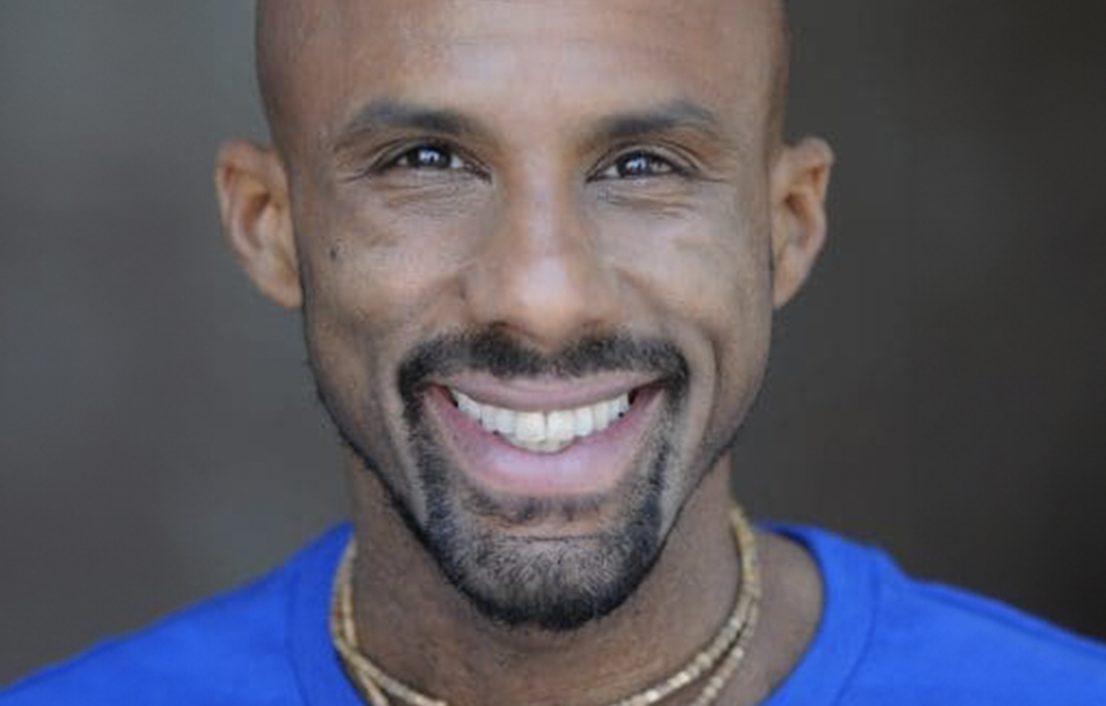
The Tune Up Fitness community is filled with leaders dedicated to educating others about human movement, SMFR, and innovative techniques. This month, we interviewed Louis Jackson to highlight his passion and expertise in empowering our community to move better and live healthier lives.
Does the name sound familiar? You may have read Louis Jackson’s forward in Jill’s latest book, Body by Breath: The Science of Practice of Physical and Emotional Resilience. Jackson credits Jill Miller with awakening his curiosity about breathing mechanics, gut massage, and proprioception, profoundly shifting his paradigm of how to live and be in the body. This awareness held him through a transformative three-month Ninniku Okyu treatment with Healing Cultures, where he learned to befriend fear and recreate his spiritual paradigm. That led to his current job as the Director of Yoga and Healing Support for Healing Cultures. With 25 years of yoga practice and teaching, he continues to explore this intersection with “intuitive healing.” He’s proud of the strong foundation he’s received from Jill and the gift of creativity it keeps on giving. He’s honored to help others develop their own healing culture and promises not to let his BA from Stanford get in the way.
Tune Up Fitness: What motivated you to start yoga?
Louis Jackson: Years ago in Houston, I lived with a housemate who had a yoga book and began to practice.
Tune Up Fitness: How many years have you been teaching yoga?
Louis Jackson: 25 years.
Tune Up Fitness: What is your No. 1 tip for teachers?
Louis Jackson: Practice for yourself; don’t be a teacher who practices just to teach. Have your own practice and then use your practice to teach a class.
Tune Up Fitness: What is your favorite rollout?
Louis Jackson: Anything dealing with the gut. Sustained compression on the navel with a ball on the belly. I enjoy feeling my heartbeat and experiencing my body breathe.
Tune Up Fitness: What is your favorite Move?
Louis Jackson: Sidewinder and its variations because it reveals so many blind spots and enhances lateral awareness. Adductor slides are also a favorite as they tie into the pelvic floor, revealing the many underlying connections on the inside of the leg.
Tune Up Fitness: How did you first discover breathwork?
Louis Jackson: Jill Miller awakened my curiosity about breathing mechanics, gut massage, and proprioception, profoundly shifting my paradigm of how to live and be in my body.
Tune Up Fitness: What do you enjoy most about teaching?
Louis Jackson: I enjoy helping others develop their own healing culture.
Read “Build a Coregeous EmbodyMap, Starring the Diaphragm” written by Louis Jackson.
Learn More about Louis Jackson.
Do you have a Yoga Tune up teacher who is dedicated to educating others about human movement, SMFR, and innovative techniques? Send us a message and nominate them!

Thank you Louis 🙏 I so appreciate the reminder to have your own practice to practice, not practice to teach. That hit home to me. I get lost in the “performance” side of me and how much I need the healing of this practice for myself, as well.
Louis your article hit home and reminded of when I had my own yoga studio in 2007-2008 I love your comment “have your own practice and then use your practice to teach a class” I loved yoga before opening my studio but I began to hate it during the time that it got really busy. I had a fulltime jog 8-4 and I taught yoga classes M-F 6-10 and often all weekend long, I stopped practicing yoga because I was just too busy and I lost my desire to practice. I actually hated doing yoga for a while. .This time around before starting the Yoga Tune up course I decided yoga is about me first. I practice often and even when i am ready to teach the plan will be 1/3 teaching 2/3 taking classes. Thank you very much for your full involvement, positive attitude and especially for your statement “trust the process” during the recent Yoga Tune Up course July 7-15, 2026. I will never forget you.
Louis you seem like the most calm and chill person! I will be embodying being a student and having my own practice. When I have taught just to teach, it’s a recipe for disaster. thank you for the reminder
Reading this blog made me question myself for a moment. What’s my motive for teaching yoga? Am I practicing yoga in order to deliver a good yoga class? I question this because I started off 15 years ago teaching yoga to teenagers because it was part of the high school curriculum. Now, that I have retired from teaching in schools, I continue to teach yoga in the community because movement has been a huge part of my life including yoga. So, I’ve validated my answer. I practice for me first and foremost in order to teach others.
Thank you for reminding me to practice for myself!
will look into Healing Cultures.
Lifelong learning informs all we do. Thank you for opening up and sharing more about you and your work. Thank you for the reminder to spend belly time on a ball.
“Have your own practice and then use your practice to teach.” This is so true! We need to really feel it in our body first to be able to teach. Just like the sidewinder, which it looked pretty easy to me at first, but I had no idea how it would challenge my muscle activation. And I had to try it over and over again to really “get it” within my body. Thank you for being involved in the Yoga Tune Up teacher training, Louis. We appreciate you!!
Yes! The sidewinder and belly work with the coregeous! Coming into this work with a dance background, at first I wanted to get the pain relief from long days of dancing and training and lacked the patience to slow down to explore exercises such as the sidewinder. It took me months to tolerate abdominal work with the coregeous due to an ED history. But wow the depth and the effects of that work continue to blow my mind!
At the risk of echoing every commenter: ‘teach for yourself first.’ It’s not selfishness: it’s so you can know in your bones (and all other components of the body) what the experience is. This is what makes us truly ready to teach. Thank you, Louis. 🙂 Glad to have you as part of my YTU certification training team. <3
Louis Jackson’s journey highlights how academic rigor and intuitive practices can complement each other in powerful ways. His emphasis on interoception and embodied awareness adds a compelling layer to the conversation around sustainable wellness. Thank you for sharing this perspective! Louis’s advice to “practice for yourself; don’t be a teacher who practices just to teach” speaks to my heart. It is something I struggle with but see great benefits from.
I totally agree with Mr. Jackson that, in order to teach others well, you must have your own practice yourself. You have to experience it to impart it.
I’m just beginning to explore the vast world of Yoga Tune Up, self-myofascial release (SMFR), and breathwork—and I’m loving every step of the journey. There’s so much to learn, and I’m especially intrigued by the role of the diaphragm and how breathwork can deepen both awareness and release.
Jill’s teachings have been a huge inspiration for me as well. Agree, her approach invites creativity and exploration, which makes the learning process feel both grounded and fun.
Next on my reading list: “Build a Coregeous EmBody Map, Starring the Diaphragm.” I’m excited to dive in and keep expanding my understanding.
This article addresses the importance of embodying and being a student of your body as Jill Miller teaches us. The more I know about how my own body responds to various asanas, the more value I can provide to the students. Keeping a global awareness of all the moving parts is crucial to helping students find their own blind spots. Mimicking poses and teaches only positional cues without giving anatomical reference is the same as treating students like Barbie dolls or models – instead of strike a pose, I’ll ask students to work towards this shape but be very mindful of how your bones, muscles, joints and mind are responding.
Louis’s number 1 tip to teachers is spot on: Practice for yourself; don’t be a teacher who practices just to teach. Have your own practice and then use your practice to teach a class. – going through and growing through major injuries and surgeries in my body opened up so much creativity in my own yoga practice. I found that creativity made me excited to teach what I was experiencing in my body and this combination of creativity and excitement has helped me to grow my student base from numbers in class to a community of movement exploration lovers!
The courageous ball and sidewinders changed my relationship to pranayama as well. The practical approach awakens curiosity and opens a path deep within. Thank for sharing Louis!
I appreciate Louis sharing about how he experienced a shift in his paradigm about how to live. He has evolved to being a teacher with a range of training and natural skills (e.g. intuitive healing) that benefit the world – me included.
Oh wow! I did not realized until now that you were the person I read in the Body by Breath book!! I am currently in the YTU training and see your friendly smile in the class. What an inspiring story you have shared with us. Thank you.
I’m stuck at the point where, after over four years of running my own yoga studio and teaching a lot of classes, I’ve lost the drive and energy for my own practice. Although I agree with Louis that you should practice for yourself first and then teach. Thanks to the balls, I’m back on the mat and practicing for myself too.
I love this interview and I am so excited I get to work with Louis during my training. I have been working with a holistic nutritionist for over a year and strongly believe in all things related to gut health. I am also very intrigued to learn more about Ninniku Okyu.
I appreciate and can relate to Louis’ commitment to breath and integrity of movement. I recently received my 300 hr YTT in Forrest-style yoga. As an on-again, off-again yoga practictioner for years, Forrest yoga’s focus on breath, alignment and longer held poses, and also the use of a roll for abdominal and all over core work and spinal extension, really spoke to me and my interest in integrity of movement. It prompted me to develop a regular yoga practice and ultimately take the YTT.
Louis’ advice for teachers to “Practice for yourself” is such an important reminder. I kmow my teaching is best when I am excited about what I’m exploring with my students. I so appreciate learning about teachers like Louis who are doing amazing work with what they have learned fom Jill Miller. Learning about the wonderful community of people sharing Jill’s work helps me envision how I can share it with my community.
It hit home where Louis says, “have your own practice and use your practice to teach a class”. I’m inspired to teach yoga in the future. I want to be able to assist in healing many at the same time~more than one at a time doing massage therapy. I do love getting inspired in classes. This is humbling because it is a reminder of being present in my own body, so much that my personal practice shines and is stronger than my goals to set this foundation.
This short and sweet interview had two great nuggets for me. “Practice for yourself” and teach to “help others develop their own healing cultures”. I’ve been doing yoga for more than 40 years. I’ve been in love with, out of love with, really really out of love with it, maybe starting to like it again. Reading this interview shone the light on: it comes down to practice for myself and I was reminded that I keep coming back to this practice (in grossly different ways since my beginning!) so that I can help others hone in on ways to be their own healer.
What an inspiring journey! His emphasis on practicing for oneself before teaching really resonates—it’s a reminder to stay authentic in our practice. I love his focus on gut health and how he connects it to overall well-being. And Sidewinder? It’s always fascinating to hear about moves that reveal hidden areas of tension. Truly motivating!
“Practice for yourself; don’t be a teacher who practices just to teach. Have your own practice and then use your practice to teach a class.”
Absolutely! I always appreciate teachers who are students first!
Thank you for sharing your story.Louis. Even after 25 years in practice you were open to learning, discovering new ways to improve your wellbeing and that of others.
Louis – your commitment to lifelong learning is inspiring to me! And I totally agree with your sentiment of practicing for oneself instead of practicing for teaching. There is so much to learn, whether it’s in yoga, pilates, or another movement discipline, that we really short-change ourselves if we get out of the habit of learning and practicing for ourselves first.
Louis’ story in Body By Breath was inspiring and helped me work with a client who has asthma. I love and resonate with his advice “Practice for yourself; don’t be a teacher who practices just to teach. Have your own practice and then use your practice to teach a class.” Although I was initially trained as a power vinyasa teacher, my practice and teaching has evolved into a functional practice (which is why I am so drawn to Jill!). I teach a functional class in a power hot studio. It is a physically challenging class…holding poses and focusing on the engagement of different muscles can be much harder than moving quicly through poses. Still, there are times I get caught up in worrying that I am not giving the students what they want! In these times I will come back to Louis’ advice. Also, I have learned to turn down opportunies to sub the fast vinyasa classes. When I have tried to do it, I can’t because it’s no longer my practice.