
Patient Care Movement: Making Accessible Movement for Chronic Illness a Reality
After being diagnosed with scleroderma, Rachel’s determination inspired her to embark on a personal journey of self-healing, while also paving the way for others who may feel underserved. Her profound understanding of anatomy and movement, combined with a deep appreciation for the role of mindset and spirit, makes Rachel an invaluable resource in the teaching community.
About the author: Interview led by Erin Wen, Tune Up Fitness content writer. Erin works as a Osteopathic Manipulative Therapist (OMT) and movement specialist for over 15 years. She has a background in classical ballet that eventually led her to become a yoga instructor. She is also a certified Yoga Tune Up® instructor and currently offers multiple treatment modalities including osteopathic manipulation, pelvic floor and pregnancy support, and movement trainings and workshops.
Erin: What inspired you to start teaching?
Rachel: I got diagnosed with scleroderma in May of 2012. In order to stay healthy, I started to practice yoga, Pilates, and lots of different styles of movement. I quickly realized there were not many people teaching to my demographic. My opportunity to take public classes became very limited. I felt there were no places that could manage my limitations.
I decided to become a teacher because I became motivated to make movement practices more accessible to people, especially those who were under-served. Ironically, getting sick made me a more functional mover.
Erin: How was the initial process of being diagnosed with scleroderma?
Rachel: Now in retrospect, I recognize that I probably was experiencing symptoms for a long time, but our sense of normal, meaning feeling ok or feeling good, can be so subjective. It’s like after you use the therapy balls, you might feel one way that you’ve never felt before, but you wouldn’t have known that state having not felt it. So I think it was the same for me, I had always been a little sick, but I had no idea. The episode in 2012 was major, my hands turned black, my fingers curled and I lost 40 lbs.
The whole process has turned into a learning experience. We have this perception that a person who is sick or disabled in this world is someone who is no longer able-bodied, but what if we reframe that? What if we are still able-bodied even with deformity? Maybe it’s Re-formity!
Movement for Chronic Illness, Disabled and Under-served Communities
Erin: How would you improve the current medical system?
Rachel: When I was young, I volunteered in the children’s hospital, I saw that healing wasn’t always happening. And this is no one’s fault, we only know what we know but I experienced too many things that were too hard on my spirit. In my personal experience, the medical system doesn’t know how to treat me. A lot of people don’t know how to treat me, I am an anomaly. That was difficult, recognizing that the only person who knows how to treat us, is ourselves. We need to do the work to educate ourselves on how we need to be treated. We are this collective of life.
Erin: What do you think is your calling?
Rachel: I feel that my calling is to move people, and I mean this in every sense of the word. I believe our words, our sounds, our expression of self and form has the potential to move people in a positive direction. So that is my calling.
I feel that my calling is to move people, and I mean this in every sense of the word.
– Rachel Lando
Erin: How has Tune Up Fitness impacted your work?
Rachel: Tune Up Fitness changed my whole life. I was a lot more limited in my ability to move before I found Jill in 2019. All of Tune Up Fitness practices are the backbone of everything that I do. It is my foundational practice. It has influenced all my work in yoga and Pilates. It also informs my anatomy teaching because describing what we feel is something everybody can perceive. To teach anatomy around what we feel is a Tune Up’s unique approach.
Erin: Which aspects of Tune Up Fitness do you apply in your teaching?
Rachel: I am a Tune Up Fitness certified instructor, I have completed all of the 3 certifications so I use aspects of all of the trainings. I open every single class with pranayama, I usually use one of Jill’s recommended breathing practices. I work with different kinds of demographics so for example, for my chair yoga students, we often start with the Coregeous ball behind the back and we go through a series of breath and movement, also with pelvic rocks.
Erin: Is there a specific exercise that has majorly impacted your life?
Rachel: Those with scleroderma are generally impacted by pulmonary fibrosis. I believe techniques such as diaphragm vacuum can add healthy stress on those tissues. I think we can change the organization of the tissues supporting the lungs. I have seen the benefits in my students and myself. I improved my PFT (pulmonary function test) scores. Recently my oxygen perfusion changed and I suspect it is through integrating these practices in my life. Diaphragm Vacuum has been very impactful in my scleroderma. I also think increasing the exhalation part of the breath, especially the way Jill teaches it as a 3-part exhalation, is hugely beneficial.
Erin: How do you integrate your teachings to cater both to the musculoskeletal system and the organ system?
Rachel: I’m thinking of the body as a holistic system. I start by addressing the nervous system, so I start with the breath. I think about the fascial components and about how breath can add space in between the neurons. I think about the fluid movement between all the systems, that’s really how I see the fascial system, as a fluid web. Depending on what the clients need, I might address the musculoskeletal system, but I really think muscles are more of a map for the pathway of the nerves. I think of the terminal endings and how they are communicating with the whole nervous system. I am thinking of balancing the electrical and the fluid systems.
Advice for New Teachers: Teaching from Lived Experience
Erin: What has been one of your most profound learning experiences?
Rachel: Dissections with Gil Hedley! Seeing the body the way he sees it is so profound. I highly encourage all teachers and anatomy enthusiasts to take the integral anatomy course. In the course, he breaks down the body parts in layers, and suddenly you have a different sense of the currents and fluid inside our bodies. To see it all on the macro level, it reframes it in your mind.
Yesterday, I sat in on a talk with Gil and one thing that was said was that our behaviors are not an expression of our character. I keep thinking we can use this kind of work so that there is alignment between our character and our behavior. That’s what I think we are striving for, and the only way to do it is through practice.
Erin: Are there any books that you highly recommend?
Rachel: Yes! Two come to mind. One is Yoga, Fascia, Anatomy, and Movement by Joanne Avison. She has a course called Myofascial Magic that I have not taken but I want to! Two is The Myofascial System in Form and Movement by Lauri Nemetz.
I also really like Pilates Applications for Health Conditions by Madeline Black. Those three ladies I really admire.
Erin: What is your teaching style? And can you give us one word to describe your classes?
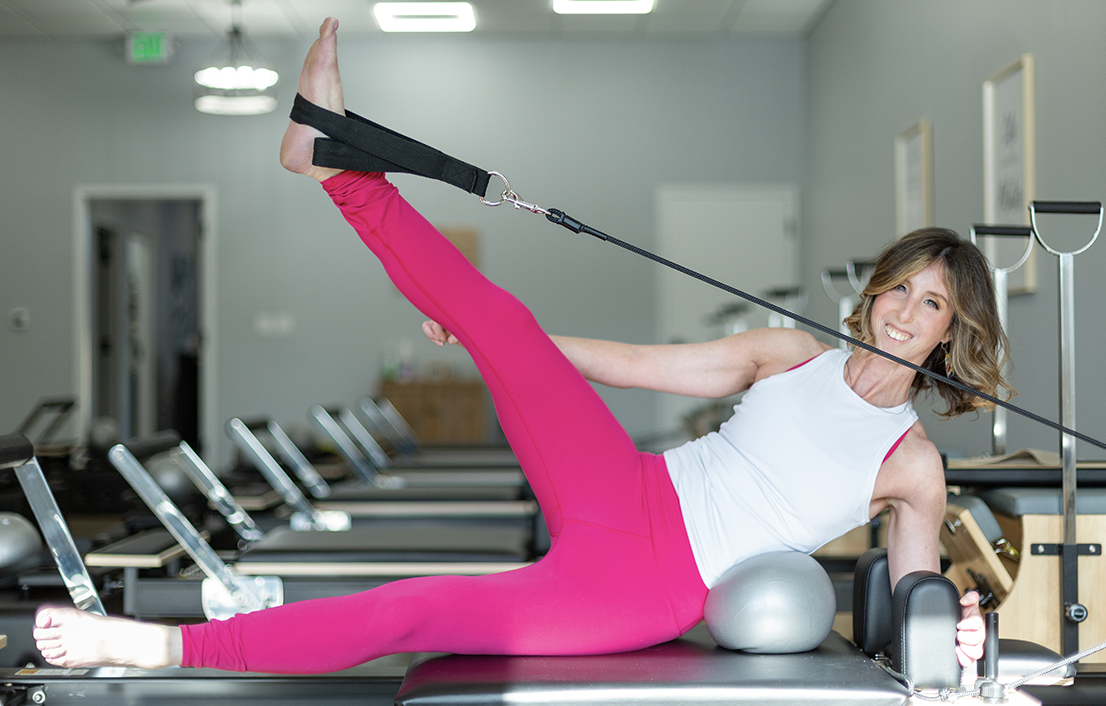
Rachel: It depends on what I am teaching because I teach so many different modalities. It is all anatomy-based, and I like to start all classes with some kind of awareness exercise. For example, I teach a class called “Reformer and Roll Model”, I will use therapy balls to bring awareness to a certain area, and then I will add in exercises to create a new tone in that region. One word to describe my classes would be “curious”.
One word to describe my classes would be “curious.”
Erin: What has been your major challenge as a teacher?
Rachel: Self-confidence. Now I think I am there, but I doubt myself more than I should. I think as teachers, we really need to trust our choice in practices and teach accordingly. Time has helped me work through the confidence, and also seeing the results in my students. The results have reassured me that what I believe is right for some people. And those sequences that I prepared help people. But I had to see it first.
How Breathwork Supports the Nervous System
Erin: How do you compliment all your teaching styles?
Rachel: I believe all 3 of Jill’s modalities can create a true relaxation in the body, that leads to more resilience in our strength training. I also believe her practices contribute to a flexibility that is more than elasticity of the tissue, but a flexibility of spirit. I love Jill’s work for that.
Yoga for me is my philosophical foundation in a way. Its core is tapas, svadhyaya, and ishvara pranidhana, which for me it’s this burning of our fire, being curious about what we study, and surrendering to what is. I need those three ideas to keep me going and find balance in all three.
And then Pilates is more effective in teaching me tubular core strength, it helps me strengthen the literal foundation of my core.
Erin: How important is the strength training part for you?
Rachel: For me, it is super important, and I think it is important for everybody, especially as we age. I interviewed Jen Fraboni, a/k/a Doc Jen Fit – and we were talking about how this all starts at age 25, and without strength or without bringing these positive stresses to our body, we won’t live as long! With scleroderma, it can affect your gastrointestinal system and absorption, which can also lead to osteoporosis, so strength training is very important.
Erin: Can you give us one advice for teachers?
Rachel: Practice, practice, practice, and teach what you do. Teach your truth.
Erin: What’s your truth?
Rachel: My truth is that I am this form because of my choices. It’s not my fault, it’s not bad or good, but the choices I made contributed to who I am. Knowing that, I need to be intentional in the choices I make and how I love myself, and how I choose the people I love in my life. With that, I also need to be intentional in the ways in which I move for the good.
Erin: How did your project Patient Care Movement come about?
Rachel: I teach at Waldorf Astoria in Park City, I teach at the local recreation center, and at a Pilates Club. In addition to this, I felt my karma work was to open the Patient Care Movement. I felt there were not enough resources for people like myself, and when you start to recognize the correlation between chronic illnesses and lack of resources, especially financial limitations, you realize people can’t afford to even educate themselves. People can’t even afford the help they need. So my goal with this project was to start a highly researched program for people with illnesses that people can afford and show up to from their own home.
I also want to share that the way the site works, I am not paying myself right now. We used the funds to put Sarah Hart, my partner in the program, through Pilates school. The goal is to start a Yoga school where people can come and train, and then they can give back to our fellows. And then that money can be invested in the education of the next student. This way, we are always handing the service baton forward. I should not be an anomaly, I should not be the strong disabled person in the room, there should be so many disabled teachers that I am not unusual. I don’t want to be inspirational, I want to be real. I hope we can create an impactful movement that can provide patient care.
Erin: How important is someone’s mindset in the process of healing?
Rachel: Jill talks about the importance of sankalpa. Leaning into your mindset and accepting that you need help. We all need help! We have evolved to co-regulate, and we are all leaning on one another. I ask people how they feel, to make noise, to take space with their sound.
 Erin: One you think you wish everyone knew?
Rachel: I wish everybody knew about Jill Miller!
Erin: What are your moves and rollouts on the go?
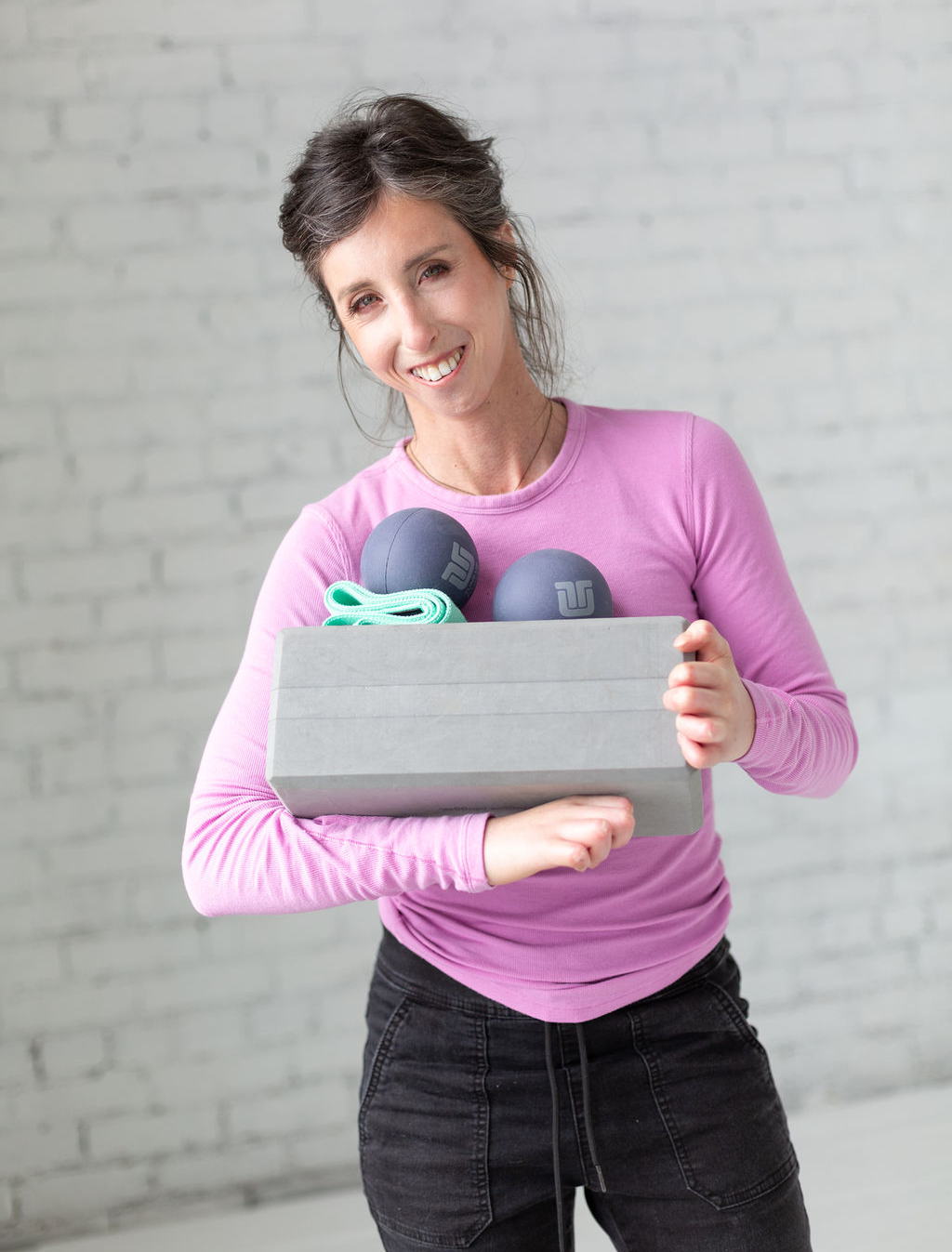
Rachel: I love to do a thoracic extension with the Coregeous Ball on the airplane or in the car because you can deflate it. I also love doing a standing side stretch against the wall with the Coregeous Ball sandwiched between the wall and my side ribs. I carry my Tune Up Therapy Balls in my purse all the time!
Erin: Do you have any upcoming trainings?
Rachel: I have an in-person Roll Model Method certification training coming up Aug 22nd-23rd in Utah.
Find Rachel Lando on the Web
Patient Care Movement Website
Patient Care Movement on Instagram

Rachel, reading your story in The Roll Model was – I’ll use your preferred word 🙂 – real. Reading this interview makes me appreciate what you do even more, and your encouragement to practice, practice, practice, and teach what you learn is a key reminder. And that you for your Patient Care Movement. I have been around & worked with folks with disabilities for many years, and love how many activists in the community remind us all that we’re only ‘temporarily able-bodied,’ that as time passes whatever movements we can do and senses we can perceive with, they will inevitably change, gradually or suddenly. We can eliminate ‘them’ from our vocabulary and simply talk about ‘us,’ as we are all in this together.
this is a really beautiful story, thank you so much for sharing it! I also agree with you, wish I had more confidence with teaching. I also wish I could pop into your reformer and roll model class! I also teach reformer and I have been dying to create a combo roll class into it! Genius
Rachel, you are an inspiration! I love your comment about “Re-formity” and I plan to use it in my yoga classes! Your statement “We need to do the work to educate ourselves on how we need to be treated.” also deeply resonates with me. Thank you for sharing your beautiful story and the way you are making the world a better place!
Thank you for sharing your story – I like how you speak to the body as a holistic system – addressing all it’s needs inside and out – so valuable.
What a great article. So much of Rachel’s mindset/philosophy resonated with me. As I was reading, I kept saying “Yes. Yes. I agree.” From having movement spaces that are more accessible for all bodies, to being intentional with your choices and how you want to show up in this world, to acceptance of what it. I think my favorite was “I don’t want to be inspirational, I want to be real.” I have found just being real resonates with my students and connects me to them so much more. They can see that I fall over in a balance pose too, and then the students feel less self-conscious when they lose their balance. They know it’s okay and that they are doing just fine.
I am inspired by Jill’s profound learning experience. Her emphasis on having in depth and first hand knowledge of anatomy to acquire a more accurate way of thinking about movement and healing is really important. Quoting Rachel “I highly encourage all teachers and anatomy enthusiasts to take the integral anatomy course. In the course, he breaks down the body parts in layers, and suddenly you have a different sense of the currents and fluid inside our bodies. “
This is such a beautiful article and I really want to embody many of the concepts she talks about, but I am not there yet. I really want my students to feel good, safe and strong in their own bodies. But I still need to build my own confidence in what I am teaching and feeling. I need to “Practice, practice, practice, and teach what you do. Teach your truth.” Thank you for a great article. I would really like to come up the Park City and take a class.
Come! There’s nothing more fun than studying with a fellow YTUer