
How Abdominal Massage May Support the Vagus Nerve and Relaxation
Key takeaways
- Abdominal massage is a self-directed practice that uses gentle pressure from a soft, grippy ball like the Coregeous® Ball to explore sensation, breath, and relaxation in the belly.
- The vagus nerve passes through the diaphragm into the abdomen so belly breathing and abdominal massage may help stimulate vagal pathways associated with rest-and-digest responses.
- Breath is your best guide. If you can take full, easy belly breaths, the pressure is likely right. If you cannot, reduce air in the ball or change position.
- Practice on an empty stomach, a few hours after eating, starting with just a couple of minutes and building gradually.
- This is self-care, not medical treatment. People living with autoimmune conditions may find it a supportive part of their routine, and anyone with a medical condition, recent surgery, or ongoing pain should check with a qualified healthcare provider first.
In my last post I talked about the role of the vagus nerve in reducing systemic inflammation and introduced the idea that abdominal massage might be a powerful tool for the many people suffering from autoimmune disorders. In this post, I will continue to expand on the science and theory behind this idea, as well as at-home abdominal exercises and techniques which you can do yourself.
Many of you are probably familiar with the work of Dr. Datis Kharrazian, whose books on thyroid and brain health are very popular among those of us interested in holistic health and functional medicine as it relates to autoimmune conditions. In Dr. K.’s book, “Why Isn’t My Brain Working?” he establishes the connection between gut and brain health and the vagus nerve’s important role in that connection. In fact, he asserts that digestive issues, such as slow motility, are often a sign of neurodegenerative issues. He recommends various techniques people can use to stimulate the vagus nerve, such as gargling, inducing the gag reflex, and singing loudly to improve the brain-gut axis. [1]
I raise this issue not to confuse my point about quelling inflammation, but to highlight the link between leaky gut, autoimmune issues, and vagal tone, and to mention the benefits of abdominal massage on the digestive system. Rolling really helps get things moving along in the digestive tract. This is due in part to the manual aspect of massage, but also highlights again the role of the vagus nerve on the autonomic nervous system. The sympathetic response increases cardiac activity and decreases digestion (when you need to run away from a tiger, your body won’t waste energy on digesting your lunch, it gets your heart pumping and sends blood to your extremities so you can run fast!); the parasympathetic system decreases heart rate (but increases heart rate variability) and increases digestion.
So, rolling right along, let’s circle back to the idea of abdominal self massage as a potential treatment for reducing the inflammation seen in autoimmune conditions. While there are no studies that I have found that either support or refute this claim, since it is a non-invasive technique that could potentially have a very positive impact on your health, it stands to reason that it is worth a try if you are attempting to heal or manage an autoimmune condition. It is very inexpensive and convenient, since it can be done in the privacy of your own home.
What Is Abdominal Massage?
Abdominal massage is a hands-on or tool-assisted practice that applies gentle, sustained pressure to the belly. When done as self-massage with a soft ball, it invites you to slow down, breathe into your abdomen, and notice how the area feels and responds.
Your autonomic nervous system has two main modes. The sympathetic, or “fight or flight,” response speeds up heart rate and puts digestion on the back burner (when you need to run from a tiger, your body won’t waste energy digesting lunch). The parasympathetic, or “rest and digest,” response slows the heart and supports digestion. Abdominal massage is one way to create conditions that encourage that second state.
The Vagus Nerve and Your Belly
The vagus nerve runs from your brainstem all the way into your abdomen. Because of that path, the sensory input from abdominal massage may help stimulate the vagus nerve and support responses linked to rest and recovery.
Breath, the Diaphragm, and Vagal Pathways
The diaphragm is the parachute-shaped muscle of respiration that separates your chest from your abdominal cavity, and the vagus nerve passes right through it. The more the diaphragm moves, the more stimulation it provides to the vagus nerve, which is why deep breathing is associated with calm feelings.
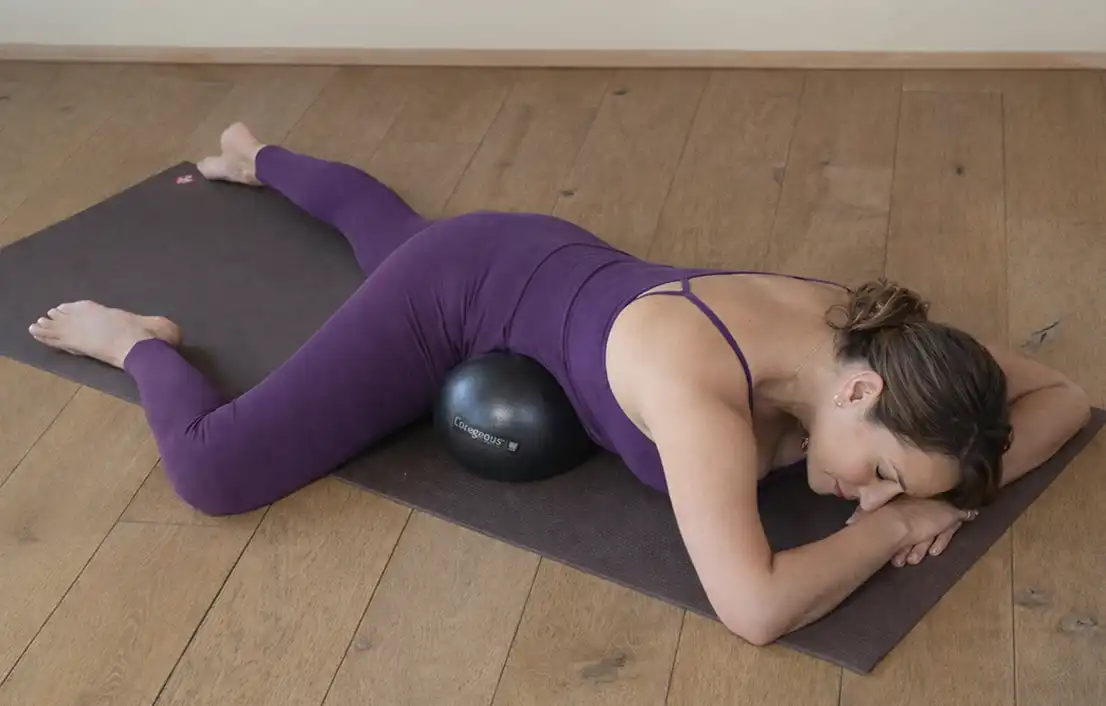
Lying prone with the Coregeous® ball under your abdomen increases the feeling of the breath. The diaphragm, in addition to its dome of muscle, also has little “tails,” call the crura, that come down and attach onto the lumbar spine (think of the pull cords of the parachute). Abdominal massage with the Coregeous® ball, helps to relieve tension in these “tails,” and in the rest of the diaphragm, allowing it to move more freely during respiration. This effect is especially noticeable to those who have suffered from respiratory problems, such as asthma, who might have even more constriction in these areas. (An additional benefit can be reduced low back pain, due to those attachments on the lumbar spine and their close relationship to the psoas and quadratus lumborum muscles, often associated as the culprits in low back issues.)
Fascia, Sensation, and the Relaxation Response
Conducting abdominal massage with the Coregeous® ball also mobilizes fascia, the connective tissue of the body. Fascia is rich with Ruffini endings, which also help to turn on our parasympathetic nervous system, inducing the relaxation response, and decreasing inflammation. The grippy texture of the Coregeous® ball helps in this process, as it has the ability to grab the skin and underlying fascia, helping to mobilize it. Having the ball directly against your skin makes it more effective.
Abdominal Massage Benefits You May Notice
Everyone responds differently, but people who practice abdominal massage regularly often report:
- A calmer, more settled feeling in the body and mind
- Easier, fuller belly breathing
- A greater sense of ease in the abdomen and low back
- Digestion that feels more comfortable (the pressure and movement may help things feel like they are “moving along”)
- Better body literacy, meaning a clearer sense of what their belly feels like day to day
Anyone who has had abdominal or bowel surgery will have additional benefits from rolling, as it can help to soften scar tissue in the region.
Abdominal Massage and Autoimmune Conditions: A Personal Perspective
I live with Rheumatoid Disease, and abdominal massage has become part of how I care for myself. I have not found studies that confirm or rule out a direct effect of abdominal self-massage on autoimmune inflammation, so I share this as my own experience, not as a promise. What I can say is that it is non-invasive, inexpensive, and something I can do privately at home.
One question comes up often for those of us with autoimmune conditions. The gut is home to a large number of lymph nodes. Massage can help to move the lymph and rid the body of toxins, stimulating the immune system. The question exists of whether stimulating the immune system in this way can increase an autoimmune response? I personally haven’t found that to be the case, however, I recommend that you start any new treatment slowly, allowing time for you to evaluate how your system is reacting. Remember, we are all different and might have different results.
How to Do a Self Abdominal Massage With the Coregeous® Ball
I recommend the Coregeous® ball because it is soft, grippy, and designed for the abdomen. Firmer or smaller balls concentrate pressure in ways that may not feel appropriate for this sensitive area.
Before You Start
- Inflate the ball to about 85%, although you can begin with less air if you experience too much pressure in your abdomen. This is particularly important to note if you have had surgery or any type of physical or emotional trauma that has impacted your gut.
- Practice on an empty stomach, a few hours after eating. Rolling on a full stomach can be uncomfortable. I like to roll before breakfast as part of my morning ritual, and bedtime is another lovely option.
- Learn the difference between discomfort and pain. Abdominal massage can feel unfamiliar at first. If you can still breathe fully, continue. If you cannot take a full breath, back off or modify. Pain tends to shift the body toward a protective, fight-or-flight state, which is the opposite of what you want here.
Step 1: Belly Breathing on the Ball
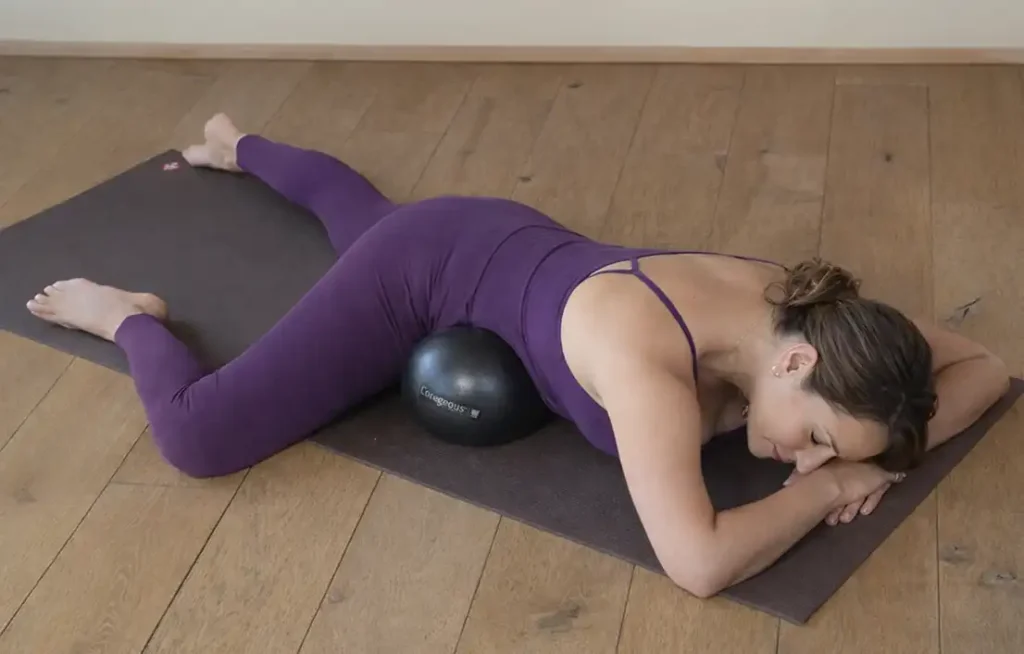
Lie down on the floor on your belly with the ball underneath your abdomen (under your belly button). Breathe in through your nose, sending the breath into your belly. Feel your belly press into the ball on the inhale, and feel the ball expanding into your abdomen as your exhale through your nose. Continue here for several breaths to several minutes, as you get used to the feeling. If the pressure is too intense, follow my suggestion for modifying below.
You want to be able to take full abdominal breaths throughout this practice. If you can’t due to pain, then you need to modify, or your efforts will be counterproductive. If the body senses pain, it reverts to survival mode; in other words, you are turning on the sympathetic – or fight or flight – nervous system, not the parasympathetic or relaxation response that you want.
However, you may find abdominal massage to be uncomfortable at first. Learn to listen to your body to determine the difference between discomfort and pain. Usually your breath will be a good indicator. If you can’t take a full breath, modify or back off. If you can still breathe fully, despite some discomfort, continue.
Step 2: Contract Relax Breathing
Continue with the ball under your belly button, inhale and inflate your belly, pressing it into the ball, then retain your breath for a couple seconds, contracting the muscles of your core and spine, before exhaling fully through your nose, relaxing your muscles and allowing the ball to excavate deeply into your abdomen. Again, continue this for a several breaths.
Skip the breath pause if you have high blood pressure, glaucoma, or are pregnant, and check with your healthcare provider if you are unsure.
Step 3: Slow Exploratory Rolling
You can then return to regular abdominal breathing while slowly rolling around on the ball, allowing the ball to explore all the areas of your abdomen, as if on a search and rescue mission for hidden tensions. If you find a spot where there is greater tension, consider lingering there while breathing deeply into the area.
How to modify if the pressure is too intense:
- Decrease amount of air in the ball. Experiment to find the right amount of air for you. You can add more air later when you are ready.
- Use a Wall. Modify your practice if the pressure is too intense, instead of lying on the ball, lean against a wall pinning the ball under your belly. In the case you have significant scarring or trauma, lie on your back, and just use your hands to roll the ball on your abdomen.
Build up to deeper work slowly.
How Often Should You Do Abdominal Massage?
Start slowly, with just a couple minutes for the entire practice, as you see how your body responds.
If there are no negative reactions, continue to gradually build the time you spend rolling on the Coregeous® ball. There is no hard and fast rule for how long you should do it. Use your body as a guide, rolling for as long as feels good to you. Practicing daily will yield the greatest results.
Abdominal Massage FAQs
What does abdominal massage do?
Abdominal massage applies gentle pressure to the belly, which many people find calming and helpful for breathing and comfort. It may help stimulate the vagus nerve and encourage the body’s rest-and-digest responses.
Can abdominal massage stimulate the vagus nerve?
The vagus nerve travels through the diaphragm and into the abdomen, so the sensory input from abdominal massage and slow belly breathing may help stimulate vagal pathways associated with relaxation. Responses vary from person to person.
Is abdominal massage safe for people with autoimmune conditions?
Many people living with autoimmune conditions include gentle abdominal massage in their self-care routines. Start slowly, notice how you respond, and check with your healthcare provider, especially during a flare or after surgery.
When is the best time to do abdominal massage?
On an empty stomach, a few hours after eating. Morning before breakfast and bedtime are both popular times.
What kind of ball is best for abdominal massage?
A soft, air-filled, grippy ball like the Coregeous® Ball is designed for the abdomen. It adapts to your belly and adds gentle shear to the skin and tissue beneath.
Build a Self-Care Practice You Control
A calmer nervous system, easier breathing, and a more comfortable belly are all things you can explore on your own terms, in just a few minutes a day. Best of all, it is a practice you control yourself.
Self-care is healthcare at its best.

Tune Up Fitness teaches educational self-care practices that may help stimulate the vagus nerve and support relaxation and resilience. These practices are not medical treatment. For injuries, medical conditions, or ongoing pain, consult a qualified healthcare professional.
Decreased stress, improved digestion, better detoxification, reduced inflammation and decreased pain are the rewards that await you. Best of all, it is a practice that you control yourself.
Self-care is truly healthcare at its best!
Sources:
- A review of Dr. Kharrazian’s brain book and the link between the brain and the gut.
- “Soothing Stress with Yoga Tune Up® Therapy Balls.” http://www.yogatuneup.com/blog/2014/10/03/the-immune-response-and-deep-breathing/ with link to Youtube video featuring Jill Miller demonstrating “Gut Smash” with the Coregeous® ball. An article that explains why deep pressure massage with Yoga Tune Up® Therapy Balls helps to relieve pain.

I’ve been working for over 6 years with a woman with parkinson’s disease and we’ve been doing a lot of abdominal massage with the corgeous ball, but I always explained to her that it’s good for the connective tissues and for the breathing. She always feels better and more relaxed afterwards, and she can reach her arms higher and breath better. Now I can add the explanation about the vagus nerve stimulation and the inflamation reduction. Thank you!
Thanks Meredith for this informative post. Are there any alternatives to the Coregeous ball that you might recommend? I think that ball has phthalates which doesn’t sound great, especially as I have a young baby at home. Thanks!
I knew about the connection between the gut and the brain and the vagus nerve connection but I had absolutely no idea that abdominal massage can aid in reducing systemic inflammation, but now when I think it about it, it makes all the sense in the world. Massaging the abdomen can help with digestive issues. If toxins are eliminated, inflammation can also be decreased. I can’t wait to try the abdominal massage using the tuneup abdomen ball.
Great and pretty clear instructions to follow. I’m amazed of how wonderful and what great tool the coregeous ball is and the multi benefits it has for the body.
Thank for sharing, the explication are simple and clear but I think the effect can be huge ! It needs to be try and incorporate to a self care routine
Thanks very much! A friend was recently diagnosed with Grave’s disease and I will bring her a Coregeous ball.
This blog post is so informative! I really appreciate you describing the link between autoimmune disease and the gut. This is a fairly new idea for me, so all of the detail was great. I can’t wait to go purchase a Coregeous ball tomorrow and try this out at home.
Thank you, I can’t wait to start the abdominal massage tomorrow befor breakfast. Thank you for sharing the scientific background and the link to Dr. Kharrazian. I live in germany, he is not very known in my country.
Thank you for this article. I tried abdominal rolling and then let it fall by the wayside. I think my Coregeous ball was overinflated, because I felt a lot of pressure and discomfort! I am quite certain that I would benefit from rolling and the effects on the vagus nerve, so I will try again! Do you think it would also regulate respiratory diaphragm pressure which could, in turn, help with pressure that causes headaches?
Thank you for this article. I tried abdominal rolling and then let it fall by the wayside. I think my Coregeous ball was overinflated, because I felt a lot of pressure and discomfort! I am quite certain that I would benefit from rolling and the effects on the vagus nerve, so I will try again! Do you think it would also regulate respiratory diaphragm pressure which could, in tern, help with pressure that causes headaches?
Thanks so much for the article Meredith. I’ve been enjoying my Coregeous ball. Sometimes I feel my pulse quite strongly in my abdomen. Is that okay? Or should I move the ball to where I do not feel my pulse? It’s not painful and I can still breathe easily and I do not have any health conditions.
Very interesting article, it seems like more and more people fight an autoimmune disease and if that can be done with better selfcare the words about the Coregeous ball should be spread!
Great article(s) Meredith! Your back ground information on the link between the ‘brain and the gut’ was very eye opening. Offering this abdominal self massage routine as an option for those with autoimmune inflammation is as you mentioned, easy, affordable and non invasive! Why not give it a try! This is thinking outside the Boxana! Thank-you for sharing.
=:0)
Loved this article and how such a simple self-care routine can provide so many benefits to those suffering from various disorders, from autoimmune, to respiratory. Health to the Vagus!
It might be important to tell people that they can expect some intense discomfort on the ball as well as some perhaps equally uncomfortable emotional responses. its just not like rolling your forearms!
Thank you Meredith. I am working with a friend with a nerve autoimmune disorder and reading your blog reinforces my resolve to teach her some coregeous routines.
Thank you for posting this information as well as the links to the Dr. Kharrazian’s book. I have an autoimmune disease and I am looking forward to trying these new methods as part of my healing process.
Thanks for this Meredith! I will be passing this on to a few friends.
I’m taking Ball Sequencing & Innovation and The Science of Rolling this weekend. I’m so stoked about these magical balls and how they are able to restore such health.
I read this article to find out more about dealing with autoimmune issues to help friends and clients. Having read all the benefits of this, I am going to start a regular practice with my coregeous ball to see if it can help with my digestive issues and if it can balance my immunity and activate my parasympathetic system, I will take those side effects. Thanks!
Fantastic and in-depth article. I was searching for help with digestion and your article was one that came up. I have used the Courageous Ball many times in a class with another instructor and at first I did not like it. I found it would make me nauseous , even though I had not just eaten. I will be purchasing my own and that way I can let out some air which I am sure will help with that.
Thank you for the information. I will be saving this to my mail for future reference.
Linda
I loooove my Coregeous ball and have been practicing abdominal massage for a little over a year now. Most of the time, I really love it and by the time I’m done, I feel down-regulated and calm. Every now and then, when i get off the ball, i have a sudden, debilitating headache. I have tried deflating the ball, but it still happens fairly regularly (once or twice a week vs 4-5 times a week where it’s fine). I’m still trying to figure out what is triggering the pain and what is different on the days where it’s fine. I am a student of my body 🙂
Thank you for the detailed explanation of how breathing impacts other systems of the body and the detailed sequence to try!
I’ve recently started using these techniques with clients, who are now completely hooked. Some clients have seen results in digestion in as little as one 15 minute session using the coregeous ball.
It has also had a great impact on my own breathing and well-being.
Love this article as I can relate and have an autoimmune disorder. The corgeous ball has been a beneficial tool in my self-care in maintaining a healthy and balanced gut.
Thank you so much for writing out these guidelines for self-treatment of the abdomen. I will be sharing this with my myofascial release clients. I really appreciate having this clear explanation to send to them so that they can further their own healing. And, I look forward to checking out Dr. Kharrazian’s work as I am not familiar with it.
What a well written article! My obsession with the vagus nerve is warranted! I cannot believe this glittery purple ball can do so much for my body! I feel like we should all learn from babies! They love it when their belly’s are rubbed! I will start adding this abdominal to my daily bustle!
I often integrate abdominal rolling with Coregeous Balls into the final minutes of my classes as a way to wind-down before relaxation. I loved this more in-depth look a why this approach is so effective.
I enjoy rolling with the coregeous ball just before bed as well. Bit uncomfortable but always worth it.
I enjoy using the coregeous ball right before bed as well. It’s not necessarily the most comfortable thing in the world but always enjoy using it. 🙂
saving this post since it is so rich with information and benefits of rolling with the coregeous ball so I can go back and read it again. I love the connection to the Vagus Nerve that you touch on in this article and I would love to learn more about abdominal massage and the vagus nerve.
Going to start doing this more regularly, probably will help my sleep too! Thank you.
This is fantastic! I have bookmarked this article to read again later. I had not considered the role of abdominal massage to help autoimmune conditions and inflammation. I spent most of my 30’s dealing with these issues and have a number of people around me struggling in this area. Thank you for such great teaching. Another tool for my toolbox..
It was interesting that you posed a question about how stimulating the lymph nodes and immune system of the abdomen could potentially increase an autoimmune response. I do regular abdominal massage as well and I have noticed tremendous freedom in my lower back muscles and diaphragm. It also helps my posture tremendously and helps me go after the adhesions between and around my ribcage. High stress periods can cause my core to collapse or get tense so physiologically changing my posture and breath also helps me create a healthy immune system response to stress.
This is so great. When people reach out to me with these concerns, I don’t have a lot to offer. This work looks great!
Yes, thank you for posting this! I’ve just started my level 1 YTU cert and am so interested in this belly rolling.
Yes! Gut brain is where it’s at! I’m so interested by all this belly rolling. Thank you for posting.
Thank you so much for this post. I have been dealing some autoimmune issues over the past 10 years (including a celiac diagnosis and possibly RA which I managed through a major dietary shift). I am always in search of alternate ways to decrease inflammation and autoimmune response. I will definitely give this a shot!
Thank you for the detailed and informative post. I have learned something new.
Thank you for this useful and detailed information. Will try the recommended modification.
Thank you for the coregeous lesson! I want to help someone I know who suffers from nerve damage, degenerative disc and arthritis. I think I should buy the coregeous ball for her, since it is the most gentle, and see how this mini lesson resonates with her. If there is any relief, I believe it may motivate her to explore what else therapy balls have to offer.
I had recently learned of the “gut brain” and then that it has many more neurons than the central nervous system (thanks to YTU Integrated Anatomy) and was aware of the effect of breath on the parasympathetic response, but this article was helpful in pulling it all together. The possibility that stimulating our gut awareness, mobility, and circulation via the Coregeous massage may impact immune response seems obvious now, but I had not heard it articulated before. My clients and I thank you for that new insight.
First of thank you for this information. Now I will have to read up on Dr. Kharrazian. I have an autoimmune disease and I’m willing to try out this abdominal work to see if it helps me. I figured that I will work on my own body to what results I get. This blog gave me lots of food for thought and has given me more information to research.
So interesting! Having seen many friends affected by auto-immune as well as being symptomatic myself, I’m always looking to better understand the causes as well as non-pharmacological solutions. Learning here about the role of the vegus nerve in inflammation and how a relatively simple abdominal massage could yield results is exciting. Can’t wait to learn the technique; both for myself and others.
Thank you for sharing. I’m excited to try some ball rolling on the abdomen to try and reduce anxiety and symptoms of auto immune desease.
Appreciate your gentle and cautious guidance; backed with quality research, explanation and written in easy to understand languaging.
Thank you for me introducing me to the idea that using the techniques for self-abdominal massage may benefit people who experience autoimmune disorders. I will be reading more of your blogs!
I too have some sort of inflammation in and around my abdominal organs and if this will help, I”ll be eternally grateful.
Je vais essayer cette pratique certainement! Je trouve très intéressant de voir tout ce que les balles peuvent avoir comme effets sur notre corps. Je les découvre un peu plus a chaque utilisation et je suis toujours très impressionnée par la sensation qu’elles m’apportent!
I’ve practiced this before. It can be uncomfortable and even strange at first, but you get used to it like anything else.
The benefits listed are amazing!
I suffer from endometriosis and I had tried the coregeous ball before but it made my symptoms worsts… maybe ill try with a lot less air and see how that goes.
Thank you for the suggested modifications. I had not considered taking the Coregeous ball to the wall or lying down on floor and moving the ball around from a supine position as a gentler way of getting the same benefits. I will remember to use them in future for friends, family and clients. Thanks again!
This blog amazing and all time provide me some useful information. I really need some this kinds of blog now today i get it.
This post is jam-packed with information! All good stuff. I just somewhat recently started rolling on the Coregeous ball regularly, and now I look forward to it every morning.
Thank you so much for this great explanation, Meredith. I do not have an autoimmune disease, but do enjoy the benefits you list here.
This subject always catches my eye, and I’m intrigued by the idea that what is essentially a form of self-manual therapy is thought to alter vagal tone. It’s clear that breathing techniques, with their link to heart rate variability and the sympathetic/parasympathetic balance, can affect the CNS. It’s also clear that stimulation of the vagus nerve has remarkable effects on inflammatory diseases (including rheumatoid arthritis and depression). What I haven’t heard is that direction pressure on the nerve at it’s insertion through the diaphragm has an impact on the vagus itself. I think it’s more likely it has an impact on the mobility and function of the diaphragm, which affects breathing, which affects the CNS. I’ll be curious to see more about this and would love to hear any more technical feedback that folks have to offer. Feel free to check out a study group I started on FB for more information on the many dimensions of the Vagus nerve – “Vagus Study Group”.
This is really interesting, i had no idea of the connection of brain and gut through the vagus nerve. I often have a tight stomach and have slowly gotten arthritis in my fingers in the last few years but never thought this could be related. Will start doing this ball move daily and report back. Thank you!
I have been meaning to roll with the coregeous ball. I have the video and hae tried it once or twice, but with your detailed and informative article I will give it a go again. I have scar tissue from a C-section 23 years ago and I know the scar tissue effects muscle functioning at time. It’s dysfunctional pairing with the transverse abdominis has come up in NKT (NeuroKinetic Therapy.) Rolling the scar seems to help. And now I will go farther with the abdominal rolling.
I love the coregeous ball. The first time I used it I had to go very slow and light, but with time I was able to go deeper. I found such relief pinning the ball and spinning it. Winding up my tissues helped release some scar tissue from a previous surgery. Now I try to use it each night before bed to help down regulate! Such a great tool!
Thank you Meredith for a very informative blog. I work with individuals challenged with MS, Lupus, RA and Lyme disease. I will encourage those I gave not yet to follow your recommendations with gut crushing. I was unaware of many of the details you provided and look forward to reading Dr. K’s book as its a topic I have much interest in. Differentiating btwn discomfort and pain is so important as it is so subjective. Thanks for the reminder to emphasize this with my clients.
Informative article on gut health and inflammation. Will pass along to those who will benefit.
Loved this! I like the modifications you’ve explained as I have tried to dive into using the coregeous ball with scar tissue from surgery in my abdomen with a fair amount of pain. These directions to take it slow, makes me feel encouraged to try again to activate my parasympathetic nervous system instead of fight or flight. I find that rolling in that area releases a lot of stored emotion in the abdomen as well. Did you experience this at first Meredith?
Thanks Meredith for this great, informative article on the benefits of abdominal rolling and such a clear “how to”. Will be sharing (and doing)!
Thank you, this is a wonderful explanation of the benefits of abdominal massage! The gut-brain connection is incredible and many-layered…it is fascinating to learn about the relationships between digestive issues, autoimmune disorders, immune system issues, and mental/emotional health.
I would have never thought of relating the gut and the vagus nerve together for autoimmune inflammation. This will be a great tool for use with many people. Thank you for the modifications as I think about my students with autoimmune disorders I know many of them wouldn’t be able to lay on the ball.
Thank you for this beautifully detailed post! As the mother of a child with autoimmune disease, I am keen to try this with my son to see if he can benefit from this technique, as we have had limited success with diet and medication.
I recently started rolling out my abdomen. Last week I felt something release while I was rolling, and my abdomen felt so much more relaxed. I’ve been studying Move Your DNA, and realized that I am constantly sucking everything in, but it’s hard to overcome that reflex! Rolling definitely helps. 🙂
Sometimes when I roll, I feel tension in my shoulders and neck. Any idea what could be causing that?
Interesting read! “Decreased stress, improved digestion, better detoxification, reduced inflammation and decreased pain are the rewards that await you. Best of all, it is a practice that you control yourself.” – Not to mention it’s cheap to give it a try yourself.
Thank you for the step by step how to use the Coregeous ball to perform self abdominal massage. It is amazing how interconnected our brains and guts are, but how little we do to manage that connection. I am intrigued with the body’s autoimmune response and inflammation and I appreciate your addition of other’s research to further look into the topic!
Autoimmunity is my area of focus as a functional health practitioner, and as I’m currently undergoing Yoga Tuneup® Teacher Training, this is a timely and pertinent article. Many of my patients suffer with digestive symptoms (“All disease begins in the gut”) and I love the idea of using the Coregeous® ball for abdominal self-massage and stimulation of the parasympathetic nervous system. This is a technique that I will definitely be recommending for my patients! Thank you for the great article.
Wow what an informative, in depth descriptive article about gut health! I had heard of leaky gut and was aware of the Vegas nerve but hadn’t thought of rolling to help!
My daughter has PCOS. Using the coregeous ball for self abdominal massage has been great. It is one of the tools she has used along with exercise and diet to help decrease inflammation. The abdominal massage helps bringing fresh blood to the organs and tissues, improves circulation, improves digestion, and has enhanced her abdominal breathing leading her toward deeper relaxation. What an inexpensive way to take care of YOURSELF.