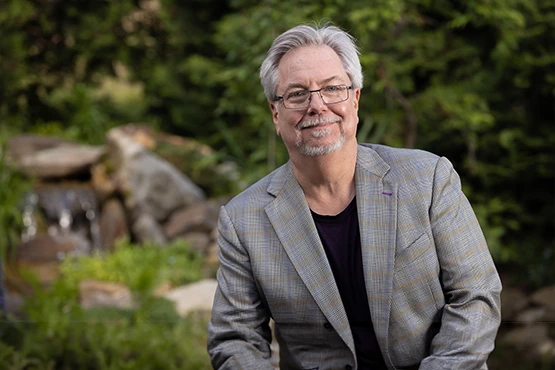
Meet David Lesondak, Fascia Specialist and Structural Integrator
Key takeaways
- Hydration is simple: drink water, move, and let thirst be your guide.
- Rolling is communication, not combat. More isn't better; tissue needs recovery time too.
- Compression and shearing do different jobs: compression flushes fluid in and out, shearing helps muscles glide against each other.
- Twisting and rotating, not just linear movement, gives fascia what it needs. Think yoga or tai chi.
- Vet a fascia specialist with the ACE test: Anatomy knowledge, Clear communication, Evocative teaching.
- Even bodyworkers need bodywork. Lesondak's advice: get worked on yourself, not just deliver it.
David Lesondak, BCSI, ATSI, FST, VMT is a fascia specialist, structural integrator, author and educator with over 30 years of clinical experience. He is the author of The Fascia Connection, Fascia: What is and Why it Matters, Fascia: What It Is and Why It Matters and Fascia, Function and Medical Applications widely recognized texts that bridge anatomy, fascia science, and integrative medicine.
David lectures and holds workshops internationally on fascia-based therapy, collaborating with medical professionals, bodyworkers, acupuncturists, and movement practitioners to provide a pragmatic, evidence-informed understanding of the body. David is an Allied Health member in the Department of Family and Community Medicine at the University of Pittsburgh Medical Center (UPMC). He serves as the Senior Structural Integrator and Fascia Specialist at UPMC’s Center for Integrative Medicine.
From Massage Therapist to Fascia Specialist: David Lesondak’s Origin Story
Erin: What was it about fascia that made you want to go deeper and understand more?
David: I always had a natural ability to diagnose through touch without necessarily knowing what I was doing – great palpation skills, even before I understood why. Earlier in my career I was a clinical massage therapist because I truly believed informed touch could get people out of pain and keep them there. I did a lot of trigger point work from Travell & Simons, knew what Rolfing was, and had heard a little about fascia, but when I had the opportunity to experience that work on myself, I realized, “This is what my body really needs!” There’s something about working with connective tissue that feels less like kneading dough and more like stretching taffy – deeply meditative for both practitioner and receiver.
I noticed I’d get good results, and clients would come back saying, “Do that thing you did last time!” I would, and it just wouldn’t get the same results, because they needed something related to that area, not identical to it. Once I had this work done on me, I understood I was close to the right thing but needed to go learn more. That’s when I got into one of Tom Myers’ Structural Integration trainings – the right training for me. That first lecture felt like fireworks going off in my brain, and I thought, “I’ve got to tell the world about it!” I just didn’t know it would take twenty-five years.
Erin: How did you become involved in the fascia research community?
David: Through Tom I met Robert Schleip in Germany, and through Robert I met Thomas Findley – the two architects behind the first Fascia Research Conference in 2007. I thought, “I might only understand ten percent of it, but I want to be in the middle of where this is happening.” As a professional, focusing on fascia gave me a template for consistent results, and I wanted to understand why it worked better than other methods – so I could mix and match protocols to fit the individual. The deeper I understood the mechanisms of change, the better my skills at manipulating them, and the more confidence I had in my own ability to get results.
Treating fascia was like going from sub-light to hyperspace in terms of getting consistent results regardless of the condition.
Erin: How did understanding fascia change the way you treat clients?
David: It completely changed the way I treat [clients]. I couldn’t go back to a traditional muscle massage. Before, doing the same technique with three clients who had the same issue, one would get better in eight sessions, another in eighteen, and one never would. Once I understood that fascia could be inhibiting the muscle, everything changed. I say in the book, “fascia treatment is for when you’re stuck.” Massage does wonderful things, but it’s not going to rearrange the furniture – if my hip is tilted, my ribs are shifted, and my shoulder’s jacked up, massage might relax things a lot without changing the arrangement of the room. Treating fascia was like going from sub-light to hyperspace in terms of getting consistent results regardless of the condition.
How to Hydrate Fascia and Understand Tissue Load
Erin: How can we keep fascia hydrated?
David: Drink water and move! Listen to your body, use the miracle of interoception: “Oh, I’m thirsty now, I’d better drink some water.” If it’s taking more energy to hold something in than to let it out, let it out.
Erin: Is there such a thing as doing “too much,” whether self-rolling or working with a client?
David: Yes. After three-plus decades of clinical experience, you get a sense of how far is far enough – if you work slowly and sensitively, you feel the resistance points; work too fast and the body says no, and you’ve tweaked the nervous system into fight, flight, or freeze.
Foam rolling is communication, not combat. I had a client with an IT band problem who rolled it for half an hour every day for a month and it wasn’t any better. I told him, “You’re continuing your own inflammatory condition” – he needed to back off and let himself recover. We have this attitude that if some is good, more must be better, and it’s okay to say “that’s enough for today” and be at peace with it. That’s part of listening to the sensory nervous system – communicating with your body, and to your therapist, since they won’t always pick up on your cues.
Erin: Do different techniques – pressure versus a shearing technique – create the same effect at a fascia level?
David: Different things do different things. Straight-on compression creates a sponge-like effect – you compress it, water squeezes out, you let go, and it reforms with the ability to take up new water. Shear gets you better movement between muscles that have to glide past each other, like the three hamstrings working in concert. Which technique is better? That depends on what’s going on.
Structural Integration, Movement, and the Tensegrity Model
Erin: Why is moving in different vectors important?
Running is wonderful but linear, that’s why I’m a fan of full-body practices like yoga and tai chi – you need something that works your body through all the fascial vectors. I once left a good yoga class feeling physically flat, and realized there had been no twists or rotations in it. Whatever you’re doing for basic physical maintenance, make sure something in the mix includes twists and rotations, not just up-and-down, front-to-back, side-to-side.
Erin: How much does a bodyworker’s awareness influence results?
David: You can absolutely affect fascia without knowing you’re doing it, but focusing on specific aspects lets you be more effective for what a person actually needs. If I keep going back to relieve the same symptom maybe I need a different approach, which is why variety matters, whether that’s a roller, a ball, or a therapist. When I’m treating a new patient, I can usually tell within two visits whether what I do is right for their needs; if I’m not seeing sustainable results by the third, either it isn’t what they need or I’m the wrong match.
It can be daunting for people to know what to try, which is why I spend a lot of the book on finding a qualified fascia therapist. I use the acronym ACE: do they know their Anatomy, and are they Clear and Evocative in their language? We don’t know what we don’t know, so it’s worth finding a good teacher to show you how to actually use a tool like a roller, rather than just going to town on an area with good intentions and no technique.
Erin: What actually happens to fascia under load, and does movement give the same information to connective tissue as hands-on work?
David: Oddly, rather than contracting under load, fascia expands – it has a negative Poisson’s ratio, behaving like “soft matter,” the same principle used in bulletproof vests, where the material expands around an impact rather than resisting it hard. And yes, movement and manual work go very well together. I remember, early in my own yoga practice, sitting in a twisted pose and feeling something expand with every inhale – I now know that was my quadratus lumborum and obliques releasing around an old injury.
I used to share clients with a yoga therapist: I’d make them aware of numb areas, and she’d show them how to use and incorporate that area better. If you can’t move somewhere, movement alone may get you there eventually, but getting unstuck first is faster. Yoga therapy and Structural Integration have a lot in common but differ – a yoga therapist uses your movement as the tool; I use my hands and your movement as the tool. I’ll often tell a client, “Notice what’s different in tonight’s class, notice what still feels stuck, and bring that back to me.”
Erin: How important is movement in resolving chronic pain?
David: Enormously important – research shows chronic conditions leading to fibrosis come partly from lack of movement, creating a catch-22 of “I’d move more if I felt better, so I won’t move.” Someone who says “I’d like to do yoga but I’m not flexible” is missing that you get flexible by doing the yoga – and you don’t need to be as flexible as the person next to you.
Erin: What’s your take on stretching?
I have a generally good opinion of stretching, but like anything you can overdo it, and it helps to stay mindful rather than chasing yesterday’s range as a benchmark. It’s about quality more than quantity; stretching isn’t conditioning. One of the most interesting bodies I ever treated was a competitive kick boxer who devoted a full quarter of his four daily training hours to stretching, to keep his body in top shape.
Erin: Can awareness of a specific structure change its physiology?
David: We ran a study at UPMC on mindfulness meditation for chronic low back pain with about a hundred people: it lessened the perception of pain but didn’t change the mechanical tissue itself. So why not do both? If you’re getting the right therapy, the body adapts – for about ninety percent of the people I treat, treatment has a beginning, middle, and end, resetting the body rather than becoming a permanent fixture.
Erin – How important is “correcting” posture?
On posture: it doesn’t matter, unless it does. A pole dancer came to me with shoulder problems and a completely flat thoracic curve; I assumed that was the issue, but treating it didn’t move the needle. When I watched her move at work, her shoulders and arms worked in ways “mere mortals” weren’t designed for. Her straight thoracic spine was an adaptation that worked for her, not the problem itself. I’ve had the opposite case too, where straightening a scoliotic curve did make a real difference. You have to understand what the person does and how they’ve adapted to it before deciding what’s an aberration and what’s a solution.
Collagen, Trauma, and Finding a Qualified Fascia Specialist
Erin: What do you think of collagen supplements?
David: Useful, under three conditions: the collagen needs to be hydrolyzed (peptides) so it’s absorbable, the dose needs to be relative to your body weight, and it needs vitamin C to be catalyzed – put it in orange juice or take a 250mg supplement alongside it. And you have to load the tissue afterward, or the collagen won’t do much good. Studies show the amino acid profile in the body peaks about an hour after taking collagen with vitamin C, so take it, wait half an hour, then walk, go to the gym, or go to yoga.
Erin: What’s your take on the criticism the Tensegrity Model sometimes gets?
David: I’d want to understand what model the critics think is accurate. We have seven competing biomechanical models for the wrist, and none are fully correct, because the wrist is enormously complex. Tensegrity holds up at the cellular level, and I’ve seen it work too many times to dismiss it. All models are incomplete, but good ones are useful; tensegrity is a genuinely useful lens for musculoskeletal and fascia conditions that aren’t responding to treatment, and that’s enough for me to keep using it.
Erin: How much do you open the door to trauma with patients?
David: Only if they open it. Some are very upfront, “six months ago my husband died”; others aren’t, and I let the patient set that pace. I do let people know this work can evoke emotional responses, and that’s completely okay, and they never need to explain themselves unless I’m hurting them and need to stop. It goes back to the same principle as physical tension: if it takes more energy to hold it in than let it out, let it out. They shouldn’t feel burdened to explain – though sometimes they want to, and that’s fine too.
Parting Wisdom: Advice for Bodyworkers, a Tip for Humanity, and a Favorite Rollout
Erin: What’s a human skill that fascinates you?
David: Musicianship – for the truly great ones, it’s an embodied practice: brain, heart, fingers, sometimes breath, all connected, reading the room and the audience. That’s anatomy, physiology, exteroception, and proprioception all at once.
Erin: What’s a piece of advice for bodyworkers?
My advice for other bodyworkers: get bodywork yourself. A lot of practitioners don’t avail themselves of what they offer others, and they build up their own repetitive-use patterns. Staying in touch with how good your own work feels is self-reinforcing. And keep moving – you can fix a lot with movement, a lot with good bodywork, and even more with a combination of both.
Erin: A tip for humanity?
David: We need to get back in touch with how good touch feels. We’ve evolved into a culture where touch reads as either violence or something sexual, when a hand on someone’s shoulder can calm their nervous system without a word – yet we can’t touch children in schools anymore. Our phones are frictionless; we touch them and think we’ve done something, but it’s no substitute for real touch. If we were more in touch with ourselves, we’d have more empathy and compassion for others – it’s easy to feel morally superior behind a screen, much harder sitting face-to-face with a person.
Erin: A favorite Jill rollout?
David: Favorite rollout: a Coregeous ball on my psoas, and a set of Tune Up balls on my suboccipitals.
More Fascia Resources
Want to go deeper into the science behind this conversation?
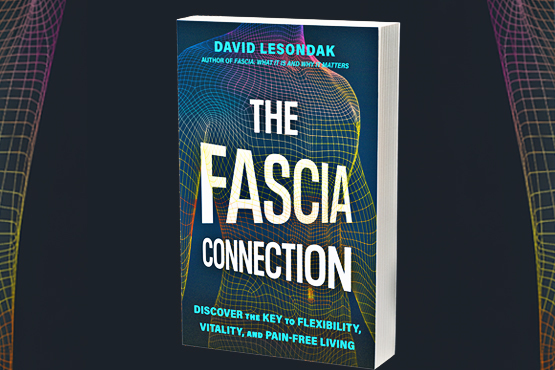
David Lesondak’s newest book, The Fascia Connection: Discover the Key to Flexibility, Vitality, and Pain-Free Living, builds on many of the ideas he shared here, from tissue hydration and load to the tensegrity model and how to find a qualified fascia therapist. It’s available now wherever books are sold.